
Malta in December: Sun, ancient stones, and a toddler who just wanted the cats
Malta had been quietly sitting on my travel list for a while. A self-contained island means you can plan a trip without the usual anxiety of figuring out how far things are from each other, which trains connect where, whether you've stranded yourself in the wrong city. Everything is just... there. Add in the history, the Mediterranean in December, and the fact that it's under three hours from Stockholm - it felt like a no-brainer. We booked it fairly quickly.
What I hadn't expected was how hard Malta is to place. It's European in its architecture and its café culture, but then you turn a corner and something about the light, the density of the streets, the rhythm of the place, feels distinctly not-European. It sits between Europe and North Africa, shaped by layer after layer of overlapping empires - ancient stones next to tatty modern blocks. You feel that mix wherever you go. It's what makes the place interesting.
The Reality Check: Malta with a Toddler
Age: 3½ years (walking, opinionated, good for about two hours of sightseeing before negotiations begin)
Season: Late December - mild (15-17°C), almost no crowds at sites, Christmas markets in full swing
Duration: A week (plenty of time, not rushed)
Base: AX ODYCY Hotel in Qawra, St. Paul's Bay - on the sea, indoor pools, kids club, breakfast included
Getting around: Hotel transfer from airport, public buses for the first two days, then a rental car from Day 3 to Day 7
Honest caveat: Food overall was a slight disappointment. Malta isn't a food destination. Manage expectations accordingly.
Arrival and a Christmas Market That Wasn't on the Plan
We took an early flight from Stockholm and were in Malta by 10am - just under three hours of flying which still feels mildly surreal when you land somewhere warm and bright. The hotel had arranged an airport transfer, which was worth every cent given the early start.
The AX ODYCY is in Qawra on St. Paul's Bay - a modern hotel right on the seafront, with a promenade running directly outside the door. For a family base it was close to ideal: indoor pools (an essential in December), a kids club, decent restaurants, and breakfast included. The breakfast spread was very good. Lunch, though, was a punchy €50 per head for the buffet - we did it once on day one, decided that was enough, and ate lunch elsewhere from then on. The hotel restaurants for dinner were fine but don't expect them to be a Malta highlight.
We checked in, rested, and were ambitious enough by late afternoon to take a bus into Valletta - a half-hour ride that the public bus handled perfectly well. Buses in Malta are decent, frequent enough, and a fraction of the price of taxis. We had no idea what we were walking into when we got off in Valletta.
It turned out to be the Christmas market, and it was lovely. Stalls along the main streets, the central squares lit up, food trucks and mulled wine and a little carnival corner with rides for kids. Diya found her people. She went on a small ferris wheel approximately four times. We ate things off sticks, drank something warm, and walked the lit-up limestone streets with that very specific Christmas-Eve-but-one feeling. It was buzzing without being chaotic, full of locals rather than only tourists. The whole evening was a complete accident - we hadn't planned to go to Valletta at all - and ended up being one of the best parts of the trip.
Back on the bus to the hotel by 8pm. Day one, in the bag.
Day Two: Aquarium and a Surprise Aviation Museum
Day two it rained, which was actually quite useful. We were planning the aquarium anyway - the Malta National Aquarium is a 15-minute walk along the promenade from the hotel - and it turned out to be a perfect rainy-day move.
I'll admit my expectations were low. How good can a small island aquarium be? Better than I'd thought, as it turns out. The shark tunnel was the standout - Diya was completely riveted, pressing her face to the glass, doing the toddler thing of solemnly informing every passing shark of its species in case it had forgotten. We spent two hours there, which is two hours more than I'd have predicted.
In the afternoon, we took a taxi out to the Malta Aviation Museum near Ta'Qali. This one was a real find - off the beaten path, run by a foundation, staffed by enthusiastic volunteers who clearly love what they do. Old aircraft, a hangar full of WWII-era vehicles and cars, and the kind of slightly improvised exhibits that feel charming rather than tired. €9 entry. Diya got to sit in a small aircraft cockpit and refused to leave for about 20 minutes. There's a small food stall on site - not fancy, but we had lunch there and it was fine. Not many shops nearby, so plan accordingly.
A quiet evening back at the hotel. By this point Diya had also discovered Maltese cats, which would become a constant motif - they're on every sun-warmed step and parked car in this country, completely unimpressed by everyone, and she would spend the rest of the trip in low-level pursuit of them.
Christmas Eve: Mdina, a Horse Carriage, and Valletta from Above
On the morning of the 24th, we picked up the rental car. Hertz has an in-town office at Pendergast Street, which means a bit of logistics to get there but is reasonable enough. (Worth knowing: the airport Hertz is fine if you'd rather pick up there, but we wanted to do the first two days on buses, so this worked out.)
Then to Mdina - the walled medieval city in the centre of Malta, sometimes called the Silent City because of its hushed, slightly haunted atmosphere. It's been continuously inhabited since around 4000 BC, which is the kind of number you read and then have to read again to make sure you've got it right. Cars are largely banned inside the walls, so the streets are quiet in a way that feels almost theatrical.
We did the one thing I'd say is non-negotiable here: a karozzin ride. These are traditional horse-drawn carriages that have been the way of moving through Mdina for centuries. Diya was, I think it's fair to say, transformed by the experience. The horse clopping along the narrow stone streets, the driver pointing things out with that half-rehearsed half-genuine tone of someone who's done this thousands of times but still likes it, and the three of us just sitting in a carriage in a medieval city. She talked about it for days afterwards.
We wandered Mdina on foot too - the views from the bastions are excellent, the cathedral square is beautiful, and there are a few good cafés tucked into the lanes. Then a short walk down into Rabat (Mdina's "outside the walls" sister town) for an hour, including the obligatory wander past St. Paul's Catacombs even if we didn't go in.
By mid-afternoon we drove down to the Valletta waterfront - the area along the harbour below the city walls. This solves the Valletta parking problem, which is otherwise notorious. There's a parking area below the bastions, a promenade with restaurants, and a public elevator (about €1) that takes you straight up into the city. It sounds ridiculous and it is slightly ridiculous, but it works perfectly. The walk along the waterfront before going up is worth doing in its own right - quiet that time of day, with views across the Grand Harbour.
We rode the elevator up to the Upper Barrakka Gardens, which sit on the city's edge and give you the postcard view of the Grand Harbour and the Three Cities across the water. The gardens themselves are small but lovely - colonnaded walkways, fountains, kids running about, and below the terrace the Saluting Battery with its row of cannons. We didn't time it right for the cannon firing on this day, but I'd recommend doing so if you can - more on that later.
Back to the car, back to the hotel.
Christmas Day: Popeye Village
Christmas Day morning we drove to Popeye Village in Anchor Bay, on the northwest coast, and this is one of those slightly unhinged Malta things that needs explaining.
Popeye Village is the actual film set built for the 1980 Robert Altman/Robin Williams Popeye movie - a cluster of wooden buildings on a small bay, painted in faded primary colours, looking exactly like a cartoon village transplanted into reality. They never tore it down. Instead, they turned it into an attraction, and I have to say it works much better than it has any right to. €15 for adults, €12.50 for kids, and you can wander the whole village - go into the houses, look at the props, watch the small shows they put on for kids, eat at the various food stalls. There's a little playground area, some boat rides in summer (not running in December), and Diya was completely in her element. So were we, honestly. There's something about wandering through a 1980s film set on Christmas morning with your toddler asking which house Popeye lived in that just works.
In the afternoon we drove back via Mellieħa town for a walk. Mellieħa sits on a ridge with views down to the bay, the streets climbing unpredictably, a parish church at the top that's comically large for the town's actual population (all Maltese churches are like this - they build them as if expecting several thousand additional residents to materialise). Plenty of cats, naturally.
A slow afternoon, dinner at the hotel, a quiet end to Christmas Day.
Boxing Day: Blue Grotto, Ancient Temples, and a Double Rainbow
This ended up being our biggest day, and the one that gave us the moment I'll probably remember longest.
We started with an early walk along the promenade right outside the hotel - the kind of slow seafront wander that's only possible when the weather is mild and no one's around. Then we drove south to the Blue Grotto.
The Blue Grotto is a series of sea caves on the south coast - in summer you take a small wooden boat out to see the cobalt water inside. In late December, the boats weren't running. December seas. The man at the ticket booth shrugged in a way that suggested this happened fairly often. The viewpoint above the cliffs is still worth a stop - you can see the cave mouths and get the basic idea - but if you're set on the boat trip, check sea conditions before making it a centrepiece.
From there a short drive to Ħaġar Qim and Mnajdra (pronounced roughly "adge-ar eem" and "mna-ee-dra" - you'll mangle the names and that's fine). These are megalithic temples built between 3600-3200 BCE. Older than Stonehenge. Older than the pyramids. And they're just sitting there on a clifftop above the Mediterranean, the small uninhabited island of Filfla floating on the horizon, with a complete lack of ceremony about the whole thing.
The visitor centre is well done - a short 4D film, interactive exhibits, and a children's room where kids can build a mini temple from giant foam blocks (this bought us a clean 20 minutes). The temples themselves are sheltered under large canopies, which sounds ugly but works, and meant we were fine when the wind picked up. Ħaġar Qim is first; Mnajdra is a 500-metre walk downhill. One ticket covers both, but keep it - you need to show it again at the bottom.
What I kept coming back to was the precision. These people, with no metal tools, built structures that align exactly with the solstice sunrise. The "porthole doorways" - holes cut through single massive stones - are so clean they look machined. Diya wanted to know why the stones had holes in them. It's a better question than most adults ask.
For lunch we drove the very short distance to Wied Iż-Żurrieq, the small cove just down from the temples, and ate at Cassarini. This was good - fresh, well-cooked, and a terrace view straight out over the sea that made us not want to leave. After lunch we walked around the cove for a bit before getting back in the car.
Then to the Three Cities, and to the highlight of the entire trip.
We headed to Senglea first. A note on logistics: parking in Senglea was easier than we'd feared. We parked below the peninsula and then drove a slow loop around the narrow medieval streets before getting out - with a toddler in tow, this is a legitimate strategy and I'd recommend it. You get a feel for the place before you're navigating it on foot.
Then we walked up to La Guardiola, a small terrace garden at the very tip of Senglea overlooking the Grand Harbour and Valletta. The streets up there are narrow and old in a way that feels slightly unreal, like the stone has been accumulating history for longer than you have any right to walk on it. And then you come out onto this terrace, with Valletta laid out across the water, and the scene is so unchanged from what it would have looked like 500 years ago that your sense of time does something odd. Game of Thrones vibes - and the show actually did film in Malta in season one, so this isn't entirely a coincidence.
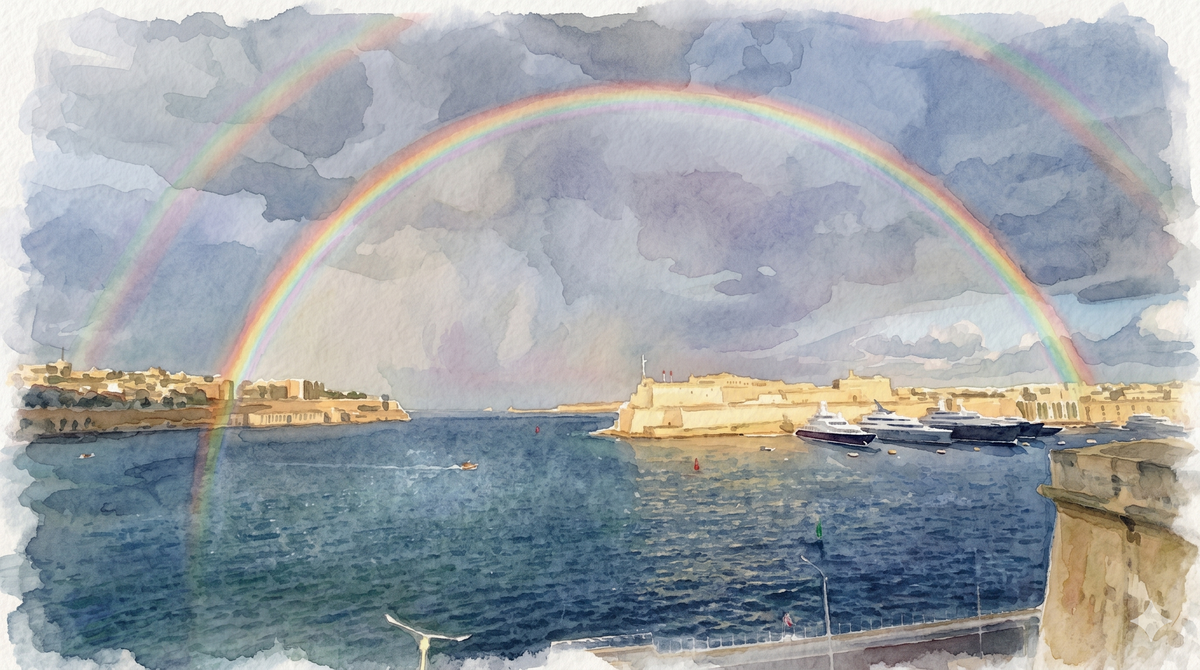
We got there just as it started raining. And then, while we were standing on the terrace wondering whether to make a run for it, a double rainbow appeared over Valletta. Both arcs, full and bright, spanning the harbour. We stood in the drizzle for a good 20 minutes, which Diya spent trying to locate the exact point where the rainbow touched the water - which is, objectively, the correct response.
We also caught the cannon firing from across the harbour - the daily salute from Valletta's Saluting Battery. A sudden boom across the water, Diya's eyes going wide. If you can time your Senglea visit for noon or 4pm, it's worth it.
Afterwards we looped around to Birgu, the third of the Three Cities, ending at Fort St. Angelo - which had unfortunately closed just before we got there. The walk along the waterfront and the views back to Valletta as the light dropped made it worthwhile anyway. Back to the hotel by 6, properly tired.
Day Six: Gozo
Gozo is Malta's smaller, quieter sibling - a 25-minute ferry from Cirkewwa in the north. You can book car spaces in advance at gozochannel.com, but here's the thing: even with bookings, even in December, the queue was almost an hour long. Just build that into your day.
The ferry itself is fine - the kind of short crossing where you're barely settled before you're arriving. Diya fell asleep, naturally.
We went first to Victoria (also called Rabat, yes, the same name as Mdina's neighbour - Malta has a real talent for confusing place names) and spent a couple of hours around the Cathedral of the Assumption. The cathedral itself is beautiful, the square in front is quiet and walkable, and the surrounding old buildings reward an unhurried wander. We had lunch here too - decent if not memorable.
Then we drove out to Mixta Cave, which was the surprise of the day. It's a small cave on the north coast with a natural opening that frames a view straight onto Ramla Bay and the sea beyond - a sort of accidental cinema screen made of rock. It's a tiny detour to reach, doesn't take long to visit, and the view from inside the cave looking out is one of those moments you want to stand in for a while.
From the cave it's a short drive down to Ramla Bay - Gozo's famous red-sand beach, properly empty in December. Diya found her version of paradise: shallow water she could splash about in, sand to dig in, no other humans for hundreds of metres in any direction. We probably spent 40 minutes there before reluctantly moving on.
Last stop was the salt pans near Żebbuġ - shallow rectangles carved into the coastal rock that have been used to harvest salt for centuries. They're still in use. The geometry of them against the sea is striking, and the light in late afternoon was perfect. Worth the small detour for photographs alone.
Back to Mġarr harbour for the ferry, which had a much shorter wait this time. Dinner that night at Aditya, an Indian restaurant on the way back to the hotel - which sounds funny to flag on a Malta trip, but we were quietly desperate for non-buffet food and it was excellent. Sometimes you just need a proper plate of dal and rice.
A Quick Detour for the Cars
This deserves a section of its own because I couldn't believe it: Malta is full of old Indian cars. Maruti Gypsys, specifically - the boxy little Suzuki-derived 4x4 that India built for its domestic market in the 1980s and 90s, which you almost never see in Europe and rarely see in India anymore either. There were just... dozens of them, parked on streets, driving around, in various states of preservation. I don't fully know why they're here (something to do with Malta being right-hand drive, with relaxed import rules, and warm enough that they don't rust to dust) but it was a delightful piece of automotive absurdity that became a small running game for the rest of the trip.
Last Day: Salina Park, Classic Cars, One Last Walk Through Valletta
The morning of the 28th split us up. I dropped my wife and Diya at Salina Park - a properly good kids' playground with serious equipment - and then took the rental back to the Hertz office. Logistically a bit fiddly but it worked. They had a great couple of hours there and Diya was completely tired out in the best way.
I'd built in a small detour for myself: the Malta Classic Car Collection in Qawra, which is a short bus ride away. It's a small private museum but a lovely one, with a couple of hundred cars from across the twentieth century, beautifully kept. If you book in advance you can actually drive one of their classics out on the road, which I didn't do this time but would absolutely do on a return trip.
After lunch and some rest, we took the bus back into Valletta for one final wander. Walking the streets at dusk, watching the limestone glow gold, eating one last set of pastizzi from a bakery - it was the right way to close the trip out. Quiet, unhurried, the city emptying out as the locals went home.
Would We Go Back?
Yes, and probably soon. Malta in winter is one of the better family trip ideas in Europe. The weather is good enough to be outside most of the day, the sites are empty, the history is serious, and a self-contained island means the logistics are simple in a way that bigger destinations rarely manage.
The food is the honest weak point - Malta isn't somewhere you go to eat well, and if that matters to you, temper expectations. But fresh fish by the sea at Cassarini, pastizzi from a local bakery for 30 cents each, the Indian dinner at Aditya, the better restaurants in Valletta - there are pleasures to be found if you don't expect them to come from hotel buffets.
What stays with me most is how many things Malta has been: European, North African, Arab, Norman, Spanish, French, British. You see it in the architecture, taste it in the food, hear it in the street names. Maltese is a Semitic language written in Latin script, which is its own strange thing. It's a small island and a lot has happened on it.
Malta with a Toddler: Quick Reference
Flight: Around 3 hours from Stockholm. Ryanair, Air Malta, and others serve the route.
When to go: October-April for quiet and mild. December worked very well - the Christmas market in Valletta is a real bonus. July-August is hot and crowded.
Base: Qawra/St. Paul's Bay or Mellieħa for a quieter, more local feel. AX ODYCY if you want an all-in-one family setup with pools, kids club, and breakfast. Sliema/St. Julian's if you prefer more urban energy.
Getting around: Hotel transfer for airport arrival, public buses for the first day or two (they're decent), then rent a car. Hertz has an in-town office. Driving is fine once you adjust to narrow roads and the general optimism about lane markings. They drive on the left.
Don't miss: La Guardiola terrace in Senglea (go late afternoon), the karozzin ride in Mdina, Popeye Village if you have kids, the temples at Ħaġar Qim and Mnajdra, the Christmas market in Valletta if you're there in December, Mixta Cave and Ramla Bay on Gozo.
Skip with toddlers: The Hypogeum of Ħal Saflieni (underground, not suitable for under-6s, requires booking months ahead anyway). Long boat trips if December seas are choppy.
Caveats: Food disappoints more than it impresses - eat fish at harbourside restaurants, eat pastizzi from bakeries, don't expect much from hotel buffets beyond breakfast. The Gozo ferry queue will be longer than you expect even in winter. Valletta parking is hard - use the elevator from the waterfront. The Aviation Museum is a great rainy-day option if you've got a kid who likes planes.
One last thing (for the Indians): Learn to spot the Maruti Gypsys, the 800s, the Tata Safaris... they're everywhere and noticing them becomes a small unexpected game for the whole trip.

